The sky is pregnant with impending storm, hanging like a damp, grey wool blanket above campus, smothering the usual Sunday sounds of church music and celebration, and stifling any cool breeze. It is a strange experience after my sunny smiling adventure of yesterday.
In my Arabic class there are several people who are my friends, and a few people who study with me. Of those, Fareed is by far the closest. He came by to visit me when I missed class because of Malaria, copies my notes, and generally is a very good person. When we were talking once about favorite foods, or maybe what I love about
[side note on trotro etiquette: (reminder: a trotro is pretty much a van with four benches in it, some working windows, stickers and sayings everywhere, no seatbelts, a very shaky chassis, and a general air of exhaustion and imminent collapse. The driver sits on one side of the front seat, which usually also holds two or three passengers, and the mate rides in the body of the vehicle with the bulk of the passengers, opening the sliding door (and sometimes holding it closed), calling out stops and destination, taking money, arguing fares, and loading and unloading the various passengers’ cargo of pieces of beds, animals, bags of produce and charcoal and anything else imaginable) When boarding a trotro, it is polite to move to the back, taking the furthest seat possible. Once a bench is filled with people (anywhere from two to five, depending on size, personal space bubble, amount of luggage, and general orneriness of the mate, who will sometimes pack people in mercilessly), the little bucket seat in the aisle is folded down and filled, completely blocking the bench behind it. If someone from the rear bench needs to get out, then, it follows that all of the aisle-seated passengers will need to get up, and out of the car, for that person to exit the vehicle. So at pretty much every stop people pile out of the trotro to let someone off and pile back in, filling in the empty space. Over the course of a ride, it is possible to go from sitting directly behind the mate in an aisle seat closest to the door to sitting in the very back corner. This, the screaming goats, the fretful small children, and the truly giant unwashed masses are all part of the charm of this form of transportation, and only add to the sense of adventure. I promise.]
It was a four-tro journey, as it turns out. We were planning on leaving at about 8:30 in the morning on the ’45-minute’ trotro ride and I thought we would return by 1:30 or so. Mikaela was going to join us but opted instead for a beach getaway vacation with Steve instead, so it was just Fareed and I walking down the main road of campus to the taxi and trotro station across the street at 8:30 on Saturday morning, discussing the myth of
The trotro stopped at Second Power, which was the stop for his parents’ house (though it looked to me like just another stretch of dirt road lined with cement walls, iron gates, lean-to stores and ditches). I spilled out of the trotro with my usual grace(lessness) to stand on the side of the road just at a footpath leading through a cornfield to another red dirt road. Waiting on a stool in the shade of an empty store was a dignified old man in a white polo shirt and a grey checked cap. He reached out to take my hand and I asked, “Ete sen?” which got a laugh and broke the ice a little. Fareed’s father (as the gentleman turned out to be), led us through the corn to his family house on the other road, behind the cement walls and a red-painted iron gate. Inside this enclosure was a paradise of tropical trees and flowers cuddled up to a blue-green house looking out on a yard with the usual dog, cats, goats, etc. Fareed’s mother came out to greet us, a beautiful matriarch wrapped in colorful fabric and carrying a little boy. She also laughed at my attempts at Twi, and the boy in her arms, Fareed’s nephew, hid his face because he had never seen a white person before and was scared of me. Soon after we arrived Fareed’s twin sister Faridah came out to say hello, and introduced me to her son (the baby), correcting me when I told her he was beautiful, because in
We walked back through the cornfield, caught a trotro to the main road passing the town, from there caught a trotro to a filling station in the village of Nswame, and from there caught another trotro heading out to the farmlands outlying the village. The roads are all dirt, and when it rains (right now about three times per week) they turn into rivers, eroding and evolving into slippery red mudslides that destroy any road-like features before hardening into clay again, leaving ruts, holes, little valleys, and dry washes inscribed permanently on the face and lying in wait for over-full trotros, taxis, big trucks, and any vehicle foolish enough or desperate enough to attempt a traversal. So the final trotro ride resembled less a ride and more a mountaineering expedition engaged on a micro level. At one point I looked out the window (with one hand on the metal side of the car so that I did not get a concussion from an unexpected rut) and took a look at the road, and just laughed, because there was a four-foot gulch in front of us with no trotro-sized path that I could find, and yet the driver dropped from first gear into some lower gear (that must only be available in rural Africa) and lay on the horn before inventing a new dimension and somehow not folding his vehicle in half. And the next thing I know? We are back to very bouncy ruts in the road, no one is blinking in surprise at the miracle we just witnessed, and Fareed is telling me that the most valuable investment someone could make in
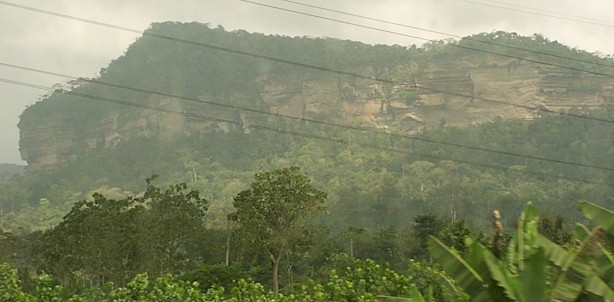
The trotro dropped us at a dirt crossroads marked by a giant tree in the middle of cornfields, orchards of pawpaw trees (skinny little anorexic palm-looking trees with clusters of papayas sitting smug and green at the top, ten feet off the ground), and general explosions of green growing things lining a round bowl of a valley cupped in the hands of beautiful grey-green mountains. Hidden behind trees was a house belonging to Fareed’s uncle, and I followed him and his father up the steps to the porch, where a be-spectacled little grey haired man was enjoying his lunch. I was introduced and he exclaimed over Fareed, who, I had figured out by this time, was a bit of a prodigal son, since he had not been to see his family since he went to secondary school at cape coast four years ago. More pictures were taken, especially of the HUGE tree and the mountains, and we proceeded up the road towards the farmhouse.
In a lot of ways being there reminded me of visits to Uncle Steve and Aunt Connie when they were living up Monticello Road, when everyone would sit on the porch and just relax and talk for hours when visitors came, but you could still feel the tasks and trials waiting for attention because it was a working ranch. This place, for all that it was in tropical West Africa and the conversation was about pineapples and plantains instead of cows and all talk was in a mixture of Twi and Ga, had exactly the same feeling of being a working farm taking time out to entertain in its own modest way. Only about one vehicle per hour passed on the road (making it very different from the Connie and Steve’s house, I know), so it was the quietest place I have been in
After the tour we sat in the yard and ate fresh-picked fruit still warm from the sun and sinfully sweet and juicy, and looked out over the fields and watched the skinny farm cats chase baby chickens until the mamma hen got mad. Fareed’s cousin Becky came out to sit with us for a while and teased Fareed for not having visited at all in the last millenium, then disappoeared to teh kitchen adn kept plyuing us with fresh fruit, folowed by kenkey with fish (all the cats came out of the woodwork for that, and were rewarded for their grumbling, mewling efforts with the skeletons from the fish, and bits that dropped from my inexperienced fingers) Fareed taught me the proper way to eat kenkey, rolling the fermented corn dough between fingers and thumb of my right hand before delicatly dipping it in the tomatoe sauce and popping it into my mouth. It is harder than it sounds and much harder than it looks, especially with the buildup of sticky kenkey dough on fingers, my tendency to take either far too much or not close to enough dough at any given time, and the bits of fish bones that the cats keep crying for. Not to mention the gorgeous view i have of mountians over the tops of corn every time i look up. Fareed suffers from the same affliction that many of my Ghanaian guy friends suffer from: they keep telling me I need to eat more. Which is wonderful, but it goes against all of my early conditioning, and also? Kenkey is really filling. Becky brought us more fruit, and I chatted with Uncle Simon about agriculture in California and growing up without plantains as a staple while Fareed and Becky took a twelve-foot-long bamboo pole and ventured into the nearest pawpaw orchard to harvest a blue plastic feed-sack full of pawpaws and plantains.
It was wonderful to get away from campus for a day, to escape to and explore somewhere so different and yet so welcoming and familiar. And, fresh fruit? Never a bad plan. But maybe the miracle of the day was how open everyone I met was. Fareed's mother wanted to know when I was coming back so that she could cook a meal for me, and invited me to stay at their house if I ever need it. His father was laughing at my jokes and observations by the time we said goodbye, and I honestly love his twin sister. The pace of life in this country is sometimes difficult to deal with, but the things I rely on in America to keep me grounded (family, friends) exist here too, and that erases or makes up for all the challenges I face. I have a Ghanaian family, and I have reached another level of comfort and connection with this country and these people. The roots I feel developing are stronger than ever now, just of a different tree than I had before. Maybe I am a different kind of person here, but I don't think so. I feel like more of myself here than I have before, like I am growing into who I want to be.




3 comments:
Hi Moreen: I am Dan's Mother. I called him a few hours ago and they said they were to going to your folk's place for Thanksgiving dinner. I told him to ask about you, and where and what you are doing and experiencing in Africa. Marge gave me your web site. You are a wonderful writer. I can just see the places through your eyes, and that is the mark of a good writer. I will enjoy reading about you year in Africa. Hayley, (my granddaughter you have met her at Dan and Marge's) went to Africa (Equiatorial Guine on a very large island off the west coast of Africa during her Freshman year . I'm sure it is near where you are. She was only there for 7 days on a mission building project. Her trip included 3 days in Madrid, Spain, and a midnight tour of London. She has since been on week long trips to Chile near the south pole, her Junior year as to the Domincon Republic and now her senior year trip will be to Panama. She is an adventerous girl. She has not yet descided on a college. She's been accepted by several. Keep up the good blogs. Sheila Chirco
thanks to the opposing forces of nature and government supervised internet, i have had less and less time to stop by your blog. but tonite the family computer stopped being a son of a whore and i was able to catch up.
this post was great! what an amazing adventure. very insightful and interesting. i'm so glad u keep writing here.
Keep up the good work.
Post a Comment