This is for Carrie [thank you SO MUCH for your letters, by the way], who wants to know the colors and smells and fashions of Ghana. Pictures are of kente cloth and haute coture, Ghana style.
Ghana is a very tactile place in many ways. People here hold hands all the time (guys with each other, girls with anyone) and embrace or touch a lot. And just the atmosphere, with its humidity and heat, feels like an embrace, albiet sometimes unwelcome. Most food is eaten with the thumb and three fingers of your right hand, and the Ghanaian handshake is a four-part affair with a mutual fingersnap at the end, very complicated to learn but awesome once you get it down.
Ghana tastes spicy. Most food is either bland calories or REALLy flavorful, mostly with peppers. Dishes are some base, like yams (white, steamed, cut into chunks), rice (plain or fried or jollof), fufu (plantian/cassava goo in a lump that you DO NOT chew, just break off pieces with your fingers [right hand only] and swallow down like oysters), kenke (fermented corn dough wrapped in banana leaves, also broken off and dipped with fingers), banku (lumps of white stuff that tastes like sourdough) or noodles. The base is then covered in some kind of 'gravy' sauce in the case of yams, rice, kenke or noodles, and soup for fufu and banku. The sauce is usually tomato based, with spices and tasty bits. Most tomato sauces have meat in them, either chicken, fish or 'meat,' which is everything from goat to beef to just-dont-ask. Sometimes, if you are lucky, there is a cabbage coleslaw kind of thing along with it all, but the veggies here are few and far between, and not so good to eat beause they are not washed well if at all and can make you very sick. So I buy tomatos and wash them at home, or I buy avocados, which are called pears over here, or pineapples, mangos, papayas, other fruit at any of the plentiful stands that are around. At the Bush Canteen, a market quarter on campus, I can get jollof rice and sauce for 30 peswas, which is $0.30. Meat is extra, but not much. A pineapple costs 50 peswas, as does a 'pear.' Any food that is 'American' is very expensive, and usually just as odd as the Ghanaian food is.
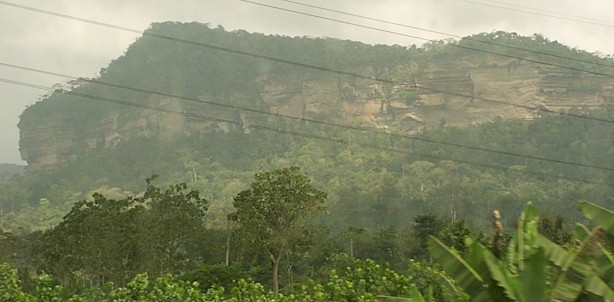
The landscape and visual stimulus are very different than California, or at least the Bay Area. There are paved roads, but they are crowded with taxis and trotros, big trucks, and a few old cars. The last time I went to Osu, I saw a Lincoln SUV, and it looked really out of place. What cars there are are European models, and at least five to ten years old. Lining the roads, as you leave Accra but are still in the urban area, are the most random assortment of goods on display for sale. Bed frames, freshly carved and stained, sit next to tropical vegegation, just hanging out and waiting for a new owner. And next door to those, sitting in the open, will be a row of cement columns, greek style, or little piles of flat stone to use in floors, or (used, almost bald) tires stacked up waiting for their next owners. There are no buildings or stalls, or any people in evidence, just stuff out there for sale. But the biggest part of the landscape is the red dirt. It makes everything that much brighter. Even my feet, when they get dirty, look exciting instead of dull brown.
And in terms of color, it is everywhere. People wear Traditional dress to be fancy (like the women to the right). Femal fashions are dresses or skirts and tops out of bright patterns, with the whole garment out of the same pattern, and they are very fitted. Men wear brightly colored shirts and slacks, or button-down european shirts, or, if they are older and not so urban, they wear a whole wad of fabric wrapped around and around, with the end draped over their left shoulder. Saturday is funeral day here, so if you leave Accra, everywhere everyone is wearing black, or black and red. Funerals are big parties, where the philosophy is to celebrate as much as possible. Many of us have been to funerals at villages or in Accra, and some girls got invited to a prince's house. They are big, public affairs, and one of the only places where Ghanaians really indulge in alcohol consumption. Even christians will have elaborate parties. On a day-to-day basis most women in the Legon/Accra area, especially at the University, where they are more affluent, dress very well, and usually in jeans or slacks, nice top or button-down shirt, and all the accessories. They spend a lot of time, money and energy putting themselves together very well, in brand name stuff too. Us obrunis are definitly underdressed most of the time, but that is taken as natural for us because we are different...most behaviors we exhibit are explained away through just plain weirdness.
Music is everywhere here. People sing all the time, play drums, talk and chatter, wake us up at five am with a sermon outside our windows (it happens every day to the boys at their dorm). And cars always use their horns for everything. When you walk past someone, chances are that they will hiss at you, which is just to get your attention so you will look at their wares. And if I trip on something, everyone who sees will chorus "Sorry!" in a very british/ghanaian manner to express their sympathy at my injury. English sounds different here, too. There is a thick accent layered on top of british diction and slang. And many of the students speak pidgin english, just because they can. There are bits and pieces of Twi and Ga and other akan languages around, and small-small (very little) bits of arabic, like when our friend Osman greeted some guys from his village with "Salaam." The more we hear and speak with Ghanaians, the more we pick these little bits of speech up. Thick accents dont bother me anymore, either. That is a big part of the acclimation process.
Things either smell really good here or really bad. There is no middle ground. Flowers and food always smell delicious, but good smells usually have to fight the bad ones, like open sewers at the markets, decomposing vegetables, or the tangible scent of 17 people waiting in line at the bank. I think my nose has gotten more work here in one month than it did each year back home.
Barbara Kingsolver wrote, in the Poisonwood Bible, that when Leah came back to the US with her family, her son thought his nose was broken because he couldnt smell anything, even in grocery stores surrounded by tons of food that SHOULD smell. There is no detachment or divide between me and my environment here. Everything is much more immediate, and more intense for it. This kind of constant sensory stimulation is tiring. I see, hear, feel more things in a day than I am used to, and beacuse they are all new and different, my brain has to process them all on the concious level, and it wears me out. Even just walking out of my hall, accross the street to the internet cafe, down to bush market, and back is a big adventure in terms of things seen and done, new experiences, people met, everything. And that doesnt even include classes, which I will have a whole section on once they actually start meeting. I just spent a few minutes trying to imagine coming from here to America as a Ghanaian, and it would be quite the cultural leap. I guess I have taken that same leap going the other way. Who knows where I will land?

Subscribe to:
Post Comments (Atom)




2 comments:
Maureen - I have read every thing you've posted and am usually moved to tears. You are an exceptional writter! What an adventure you are on - please remember how much we love you.
Melva
Again, I am really impressed with the articulate voice you have, Maureen. Your stories are always entertaining! I was laughing so hard at your descriptions of parades in your past, mostly because I made you be in them! Thank you for understanding that the parade wasn't about you but was about the community, but as different from the Cape Coast parade as America is different from Africa. Remember the Wagenknecht family kazoo entry in the holiday parade?
Thank you for your beautiful insights.
Susan
Post a Comment